Much of the mainstream reception to the inaugural Enhanced Games held on May 24 in Las Vegas was so hostile and antagonistic that Christian Angermayer, one of its chief funders, said that they received opprobrium from their opponents and proponents alike. Even though the Guardian wrote that the prevailing emotion after the event was relief, the overarching reception had a ring of schadenfreude to it, mostly because (and contrary to expectations) only one record- in men’s 50m freestyle– fell.
Indeed, measured against the enthusiastic and provocative record breaking claims made by its founders and some athletes like Kerley, the Enhanced Games failed to live up to its billing. But measured against the stark realities of world sport, usually governed by monopolistic federations and an overarching anti-doping overseer -the World Anti Doping Agency (WADA) – the Enhanced Games’ thesis is coherent and defensible and entirely necessary.
What is the Enhanced Games:
The Enhanced Games is a competition that allows athletes to use performance enhancing mechanisms. These range from drugs such as testosterone to swim suits which are usually banned from mainstream competition. Athletes at Enhanced Games are not only allowed to deploy these performance boosting mechanisms, but would also be financially rewarded in ways mainstream sport rarely rewards its athletes. To this effect, organizers advertised up to $25 million in total athlete compensation, with each event carrying a $500,000 purse, $250,000 for first place, appearance fees, and headline bonuses of $1 million for breaking the world record in the men’s 50m freestyle and the 100m sprint.
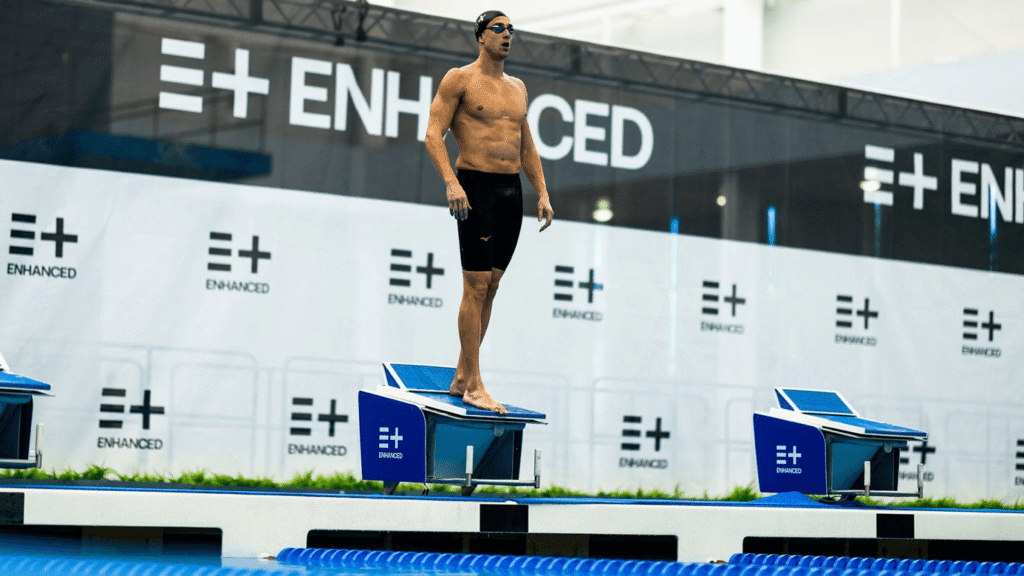
On the day of the event, the programme consisted primarily of weightlifting, sprinting and swimming and was staged before a modest crowd inside Resorts World. In the men’s 100 metres, Olympic silver medallist Fred Kerley crossed the line in 9.97 seconds, notably insisting afterwards that he had competed without enhancement. In the pool, the organisers finally obtained the spectacle they had spent months marketing for when Greek swimmer Kristian Gkolomeev swam 20.81 in the 50m freestyle, surpassing the standing world record. Elsewhere, performances ranged from respectable to underwhelming, but several athletes recorded personal bests.
This is the system the Enhanced Games are up against:
The Anti Paying Regime
Athletes in the modern Olympics are hardly remunerated. This non remuneration stance traces back to the 19th Century amateurism ideal by Olympics’ founding father Pierre De Coubertin who believed that sports’ values lay in how it builds an athlete’s character instead of their pockets. Over 130 years later, the current IOC president Kirsty Coventry continues to double down on this ideal saying she does not believe in paying athletes. Instead, she maintains that the International Olympic Committee’s (IOC) role is to indirectly support athletes by redistributing its revenues down to national federations and development programs.
However, unlike Coventry, not many under the Olympic family are amateurism fundamentalists. Just months after the Enhanced Games was announced, World Athletics president Seb Coe announced that gold medallists in each of the 48 athletics events at the 2024 Paris Olympics would receive $50,000, making athletics the first sport to introduce prize money at the Olympic Games.
As track and field athletes welcomed Coe’s announcement, the IOC’s Director General, Christophe De Kepper, took home an annual compensation package exceeding $1.4 million in 2024, as per documents made publicly available by the investigative outlet ProPublica. The Olympic Games Executive Director, Christophe Dubi, pulled in over $1.7 million. The IOC usually justifies its commercial scale by presenting itself as a non-profit redistributor of Olympic revenue, claiming that around 90 per cent of the money it generates is returned to sport and athlete development, while the remaining operational machinery is responsible for negotiating broadcasting rights, managing global sponsorships and delivering the Games across successive host cities.
Still, no matter how complex the IOC’s modi operandi are, the justification for the executive’s hefty packages falters when one compares it to how much the President of the European Commission, Ursula Von Der Leyen, earns. Von Der Leyen, who manages an annual continental budget of over $185 billion (€160 billion) and oversees the political and economic affairs of 450 million citizens, earns a set basic salary of roughly $500,000 (€430,000) a year, before allowances. Simply put, unelected sports administrators managing a two-week sport event can be paid close to, or more than, triple the officially set basic salary of Europe’s highest political executive.
What’s more, a look at the finances of the WADA and the Athletics Integrity Unit (AIU) reveals a funding model that places the financial burden of policing athletes squarely on taxpayers from countries that comply with the WADA code and the commercial ecosystem of the athletes themselves. Take WADA, which announced that its annual budget had increased to $57.5 million in 2025. Its core contribution budget is sustained by a 50/50 split: half is provided by the Olympic Movement (the very same IOC that does not believe in paying its athletes), and the other half by public authorities.
Meanwhile, the Head of the AIU receives a total annual compensation of over $417,000—a figure that exceeds even the officially reported remuneration of the Secretary-General of the United Nations, which was set at $275,420 in 2025 .
Yet, for all its corporate bloat, the AIU is at least bound by World Athletics’ own rules to disclose the remuneration paid to its Board members and to the Head of the Integrity Unit in each annual report. WADA’s finances are far more inscrutable as they do not itemize the individual salaries of its top executives. Instead, executive compensation is quietly buried inside an aggregate “staff costs” line item.
Outside of a small percentage of heavily endorsed superstars, the average Olympian relies on a precarious patchwork of national federation stipends and part-time jobs just to afford and sustain elite coaching and travel.
The Anti Doping Regime
As for ensuring that athletes compete clean, the sporting order relies on WADA’s global network of accredited laboratories. To earn and maintain accreditation, a laboratory must satisfy WADA’s very own International Standard for Laboratories, a proprietary framework that governs everything from the analytical methods a lab must have at its disposal, to how samples are stored, documented and reported. There are currently around thirty laboratories worthy of WADA’s accreditation worldwide.
It is not that the world is bereft of appropriate laboratories that meet scientific standards. Thousands of laboratories across the world are certified to ISO/IEC 17025, the internationally recognised benchmark for laboratory competence. These are credible and functional facilities as per conventional scientific standards, but they are not good enough for WADA’s testing and surveillance purposes.
Still, even with WADA’s stringent standards, its own record as an enforcement body is not without blemish. In 2016, an independent investigation commissioned by WADA itself found that more than 1,000 Russian athletes had benefited from a state-sponsored doping programme between 2011 and 2015. More recently, it emerged that 23 Chinese swimmers had tested positive for a banned heart medication in 2021, months before the Tokyo Olympics. WADA cleared all 23, accepting China’s explanation that the positive results were caused by contaminated food at their hotel. The positive results came to light three years later, by which point China had clinched two Olympic gold medals in Tokyo, and eleven of implicated athletes were named in China’s roster for Paris 2024.
When the Chinese case broke, the charge of bad-faith politics flowed from WADA and China in unison toward United States Anti-Doping Agency (USADA) chief Travis Tygart who claimed the global body had swept the positives under the carpet. WADA dismissed his remarks as politically motivated and defamatory, and China’s anti-doping agency, CHINADA, branded USADA’s congressional manoeuvring an exercise in “out-and-out hegemonism” and “long-arm jurisdiction,” its intent to politicise the case “all too clear.” This very same vocabulary of politicisation was invoked by Russia against WADA when they were on the back foot, declaring that WADA acted as “investigator, prosecutor and publisher.”
While nations with accredited labs debate over who is weaponising the system, Africa, which has no WADA accredited lab, supplies more than a third* of sanctioned athletes in the AIU list. The continent’s only accredited laboratory in South Africa lost its accreditation in May 2025 after failing to satisfactorily resolve multiple non-conformities with the ISL. Because there is no lab worthy of WADA’s approval in Africa, every doping control sample collected from an African athlete is usually exported to Qatar, India, Portugal, Spain or Turkey at a cost of between $600 and $780 per test.
These bills often fall on national anti-doping agencies at the ultimate expense of the taxpayer. In Kenya, for example, the government pledged $25 million— $5 million annually—toward anti-doping efforts, primarily to satisfy World Athletics and avoid international athletic bans due to the high number of doping cases in the country. To put this funding into perspective, the $5 million anti-doping compliance pledge is nearly three times the entire annual budget allocated to Kenya’s National Research Fund, the state body tasked with financing academic and scientific innovation across all public universities. Instead of utilizing state funds to build domestic scientific capacity, developing nations are forced to underwrite the logistical nightmare of exporting their own biological data.
Furthermore, as of May 2026, there are 239 African athletes* currently serving a ban under the AIU. Compare that to how the continent fared in athletics at the most recent Olympics in Paris 2024: across all 54 nations, just 27 African athletes won medals in track and field. The same system that has built much of its enforcement apparatus beyond Africa’s borders churns banned African athletes at nearly nine times the rate it produces medallists. Then, bills them for it.
The Anti-Anti Paying/Doping Regime
A large number of athletes at Enhanced were past their prime, a factor which, again, should speak for something about the current system and the post-career prospects it has (or not) for its stars. Enhanced Games’ men’s 100 metres field averaged 33 years old, compared to 26.1 — the average age in the 100m line up when Usain Bolt broke the world record in Berlin. In the pool too, the men’s 50m freestyle field at Enhanced averaged 33, while the final of the same event at the Paris 2024 Olympics averaged 27.25.
Furthermore, that only one record was broken at the Enhanced Games ought to have triggered questions on whether the current system is even effectively policing “clean” participation. Either enhancement matters far less than the policing apparatus assumes, or the records it was measured against were not as clean as the medals suggested.
The Enhanced Games may simply have failed to outstrip mainstream competition because its thesis arrived before the athlete pipeline required to fully test it. The jury, therefore, is still out. Whichever way the gavel sways, the current system has little cause for comfort. Should enhancement eventually rewrite the record books, it will have been out-innovated; should it not, the justification for the sprawling anti-doping regime falters.
Nonetheless, there are valid concerns regarding the health risks pertaining to chemical and medical enhancement. Enhanced Games themselves concede there are risks to this endeavour, choosing to work with qualified medical personnel and allowing athletes the choice on whether to compete enhanced or clean. These concerns have taken up the largest chunk of the discourse, overshadowing the political economy that warrants Enhanced Games’ existence in the first place. But it should not be the bath water we drown the baby in, all while athletes choke in precarious careers and taxpayers in developing nations fund their downfall. When Angermayer says they are the good guys, I don’t see how they are not.
*From the AIU's Global List of Ineligible Persons (consolidated list dated 1 May 2026). The number accounts for athletes whose listed nationality is an African country — using the nationality field — excluding coaches and support staff.
Author's note: This article was partly developed and edited with the assistance of LLMs . The argument and final editorial responsibility remain my own.